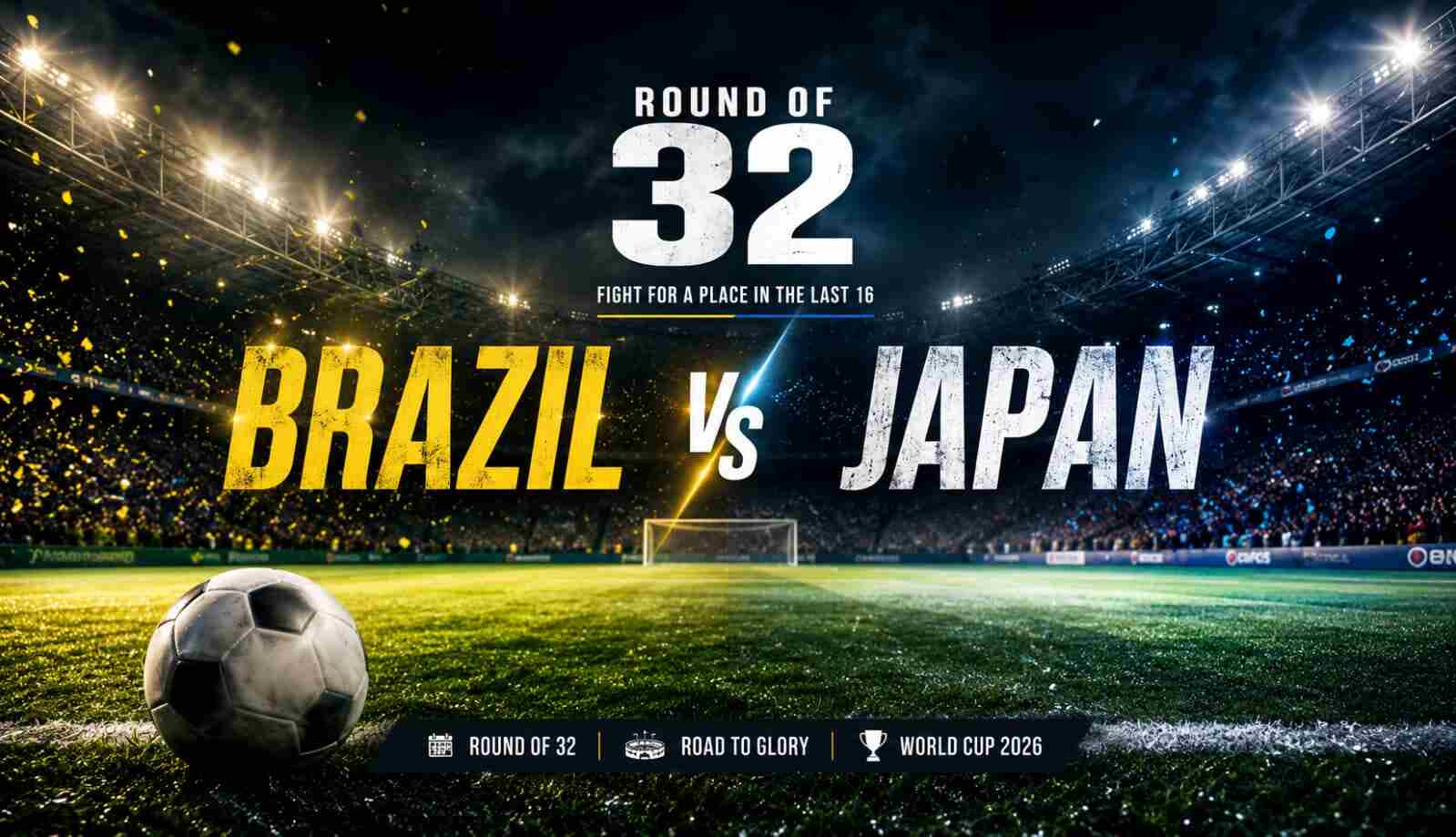
Brazil and Japan meet in the Round of 32 after coming through the group stage unbeaten, but they have reached this point in different ways. Brazil finished top of Group C with seven points, opening their campaign with a convincing 3-0 victory over Scotland before drawing 1-1 with Morocco and finishing with another 3-0 win over Haiti. Carlo Ancelotti’s side never looked rushed. They controlled matches when they needed to, stayed organised without the ball and rarely allowed opponents to build sustained pressure.
Japan also arrive full of confidence after finishing second in Group F with five points. Hajime Moriyasu’s team began with an entertaining 2-2 draw against the Netherlands, followed it with a dominant 4-0 win over Tunisia and secured qualification with a 1-1 draw against Sweden. Throughout the group stage, Japan showed they can adapt to different opponents without losing their identity, remaining disciplined defensively while carrying a threat whenever they broke forward.
History favours Brazil, who have won 11 of the previous 14 meetings between the two nations. However, Japan claimed a 3-2 victory in their most recent encounter during the 2025 Kirin Challenge Cup, proving they have the quality to trouble one of world football’s biggest names. That result may have come in a friendly, but it should remind Brazil that this is not a tie they can afford to underestimate.
Brazil Tactical Analysis
Brazil are expected to continue with Ancelotti’s 4-3-3, a system that has brought control more than chaos during the group stage. Rather than attacking at every opportunity, Brazil have been patient in possession, building through Casemiro and Bruno Guimarães before looking for the pace of Vinícius Júnior and Rayan in wider areas. Their front three constantly rotate positions, making it difficult for defenders to hold their shape for long periods.
One of Brazil’s biggest strengths has been how comfortable they look without the ball. The midfield stays compact, the full-backs choose their moments to join attacks and the defensive line rarely gets stretched unnecessarily. That organisation has allowed Brazil to recover possession quickly before launching another attack.
Against Japan, the wide areas could become decisive. Vinícius will look to isolate defenders in one-against-one situations, while Matheus Cunha’s movement across the front line should create spaces for runners arriving from midfield. Japan’s back three have defended well throughout the tournament, so Brazil may need patience rather than forcing attacks too early. If they move the ball quickly enough to pull Japan’s defensive shape apart, the openings should eventually come.
Brazil World Cup 2026 Squad
Goalkeepers
Alisson (Liverpool), Ederson (Fenerbahçe), Weverton (Grêmio)
Defenders
Marquinhos (Paris Saint-Germain), Gabriel Magalhães (Arsenal), Bremer (Juventus), Ibañez (Al Ahli), Léo Pereira (Flamengo), Danilo (Flamengo), Alex Sandro (Flamengo), Douglas Santos (Zenit Saint Petersburg)
Midfielders
Casemiro (Manchester United), Bruno Guimarães (Newcastle United), Fabinho (Al Ittihad), Danilo (Botafogo), Lucas Paquetá (Flamengo), Ederson (Atalanta)
Forwards
Vinícius Júnior (Real Madrid), Raphinha (Barcelona), Matheus Cunha (Manchester United), Luiz Henrique (Zenit Saint Petersburg), Igor Thiago (Brentford), Endrick (Real Madrid), Gabriel Martinelli (Arsenal), Rayan (Bournemouth), Neymar (Santos)
Brazil Players to Watch
Vinícius Júnior
Vinícius has been Brazil’s biggest attacking threat throughout the tournament, scoring four goals during the group stage. His acceleration and direct running make him difficult to defend in one-on-one situations, particularly when he cuts inside from the left. Japan’s defence has stayed compact so far, but Vinícius only needs a small gap to create a chance.
Neymar
Neymar offers something different. Rather than relying on pace, he looks to receive the ball between the lines and dictate attacks through his passing and vision. His record of nine goals against Japan also shows how comfortable he has been against this opponent over the years, making him one of Brazil’s most dangerous creative players.
Matheus Cunha
Cunha gives Brazil a physical presence through the middle while remaining mobile enough to drift into wider areas. His movement helps create space for Vinícius and Neymar, and his ability to hold the ball under pressure allows Brazil to keep attacks alive around the penalty area.
Our Predicted Lineup for Brazil
GK: Alisson Becker
LB: Douglas Santos
CB: Gabriel Magalhães
CB: Marquinhos
RB: Danilo
CM: Bruno Guimarães
DM: Casemiro
CM: Lucas Paquetá
LW: Vinícius Júnior
ST: Matheus Cunha
RW: Rayan
Japan Tactical Analysis
Japan are expected to continue with their well-drilled 3-4-3, a system that has given them the flexibility to defend compactly before breaking forward with speed. Rather than competing with Brazil for possession, Hajime Moriyasu’s side are more likely to stay organised, close central passing lanes and wait for opportunities to attack the spaces left behind Brazil’s advancing full-backs.
Japan World Cup 2026 Squad
Goalkeepers
Tomoki Hayakawa (Kashima Antlers), Keisuke Osako (Sanfrecce Hiroshima), Zion Suzuki (Parma)
Defenders
Yuto Nagatomo (FC Tokyo), Shogo Taniguchi (Sint-Truiden), Ko Itakura (Ajax), Tsuyoshi Watanabe (Feyenoord), Takehiro Tomiyasu (Ajax), Hiroki Ito (Bayern Munich), Ayumu Seko (Le Havre), Yukinari Sugawara (Werder Bremen), Junosuke Suzuki (Copenhagen)
Midfielders
Wataru Endo (Liverpool), Junya Ito (Genk), Daichi Kamada (Crystal Palace), Koki Ogawa (NEC Nijmegen), Daizen Maeda (Celtic), Ritsu Doan (Eintracht Frankfurt), Ao Tanaka (Leeds United), Kaishu Sano (Mainz), Takefusa Kubo (Real Sociedad)
Forwards
Ayase Ueda (Feyenoord), Keito Nakamura (Reims), Ito Suzuki (Freiburg), Kento Shiode (Wolfsburg), Keisuke Goto (Sint-Truiden)
Japan Players to Watch
Ayase Ueda
Ueda has quietly enjoyed another productive tournament, scoring twice during the group stage. He thrives inside the penalty area and rarely needs many opportunities to make an impact. Against Brazil, his movement between Gabriel Magalhães and Marquinhos will be vital if Japan are to make the most of their counter-attacks.
Daichi Kamada
Kamada remains Japan’s creative heartbeat. He links midfield with attack, finds space between opposition lines and has already shown his eye for goal with two strikes during the group stage. His decision-making in transition could be one of Japan’s biggest weapons.
Zion Suzuki
Suzuki may once again become one of Japan’s busiest players. Brazil have consistently created chances throughout the tournament, meaning the goalkeeper will need another composed performance. His shot-stopping, command of the penalty area and ability to organise the defence could keep Japan in the contest if Brazil begin to build sustained pressure.
Our Predicted Lineup for Japan
GK: Zion Suzuki
CB: Hiroki Ito
CB: Ko Itakura
CB: Ayumu Seko
RWB: Yukinari Sugawara
CM: Ao Tanaka
CM: Daichi Kamada
LWB: Keito Nakamura
RW: Ritsu Doan
ST: Ayase Ueda
LW: Daizen Maeda
Brazil vs Japan Tactical Battle
This is a meeting between two teams that are comfortable sticking to their own identity. Brazil will look to control the game through possession, while Japan are unlikely to be concerned about seeing less of the ball if it allows them to defend in a compact shape and attack with purpose when opportunities appear.
The biggest question is whether Japan can stop Brazil from creating overloads in wide areas. Vinícius Júnior and Rayan like to stretch the pitch before driving inside, while Douglas Santos and Danilo can provide support from full-back. If Japan’s wing-backs are pinned too deep, Brazil could begin to dominate territory around the penalty area.
Japan’s best opportunities are likely to come in transition. When Brazil commit players forward, Kamada’s vision and Ueda’s movement offer a route through the middle, while Maeda and Doan have the pace to exploit any space left behind. Brazil have looked well organised defensively throughout the tournament, but they will still need to react quickly whenever possession is lost.
Midfield could quietly become the deciding factor. Casemiro and Bruno Guimarães give Brazil experience, composure and control in possession, whereas Tanaka and Kamada bring energy and quick forward passing for Japan. If Brazil dictate the tempo, they should spend long periods in Japan’s half. If Japan can disrupt that rhythm and turn the game into quick transitions, they have the players to make life uncomfortable.
This feels like a match where patience will be tested on both sides. Brazil are unlikely to force attacks if the spaces are not there, while Japan know they do not need many chances to stay competitive. Small moments, rather than constant pressure, could have the biggest influence on the outcome.
Brazil vs Japan Recent Match Performance
| Match Statistic | Scotland vs Brazil (0-3) | Brazil vs Haiti (3-0) | Brazil vs Morocco (1-1) | Netherlands vs Japan (2-2) | Tunisia vs Japan (0-4) | Japan vs Sweden (1-1) |
|---|---|---|---|---|---|---|
| Expected Goals | 4.33 | 1.75 | 1.26 | 0.59 | 2.13 | 1.21 |
| Shots on Target | 9 | 5 | 5 | 3 | 5 | 3 |
| Shots off Target | 7 | 2 | 4 | 6 | 3 | 3 |
| Blocked Shots | 5 | 1 | 3 | 1 | 3 | 2 |
| Possession | 54% | 57% | 51% | 40% | 62% | 52% |
| Corner Kicks | 6 | 4 | 6 | 4 | 5 | 2 |
| Offsides | 1 | 8 | 0 | 0 | 1 | 3 |
| Fouls | 11 | 13 | 16 | 7 | 15 | 20 |
| Throw-ins | 10 | 20 | 17 | 19 | 23 | 14 |
| Yellow Cards | 2 | 1 | 2 | 0 | 0 | 1 |
| Goalkeeper Saves | 5 | 3 | 2 | 4 | 0 | 4 |
| Goal Kicks | 4 | 5 | 4 | 7 | 5 | 6 |
| Crosses | 2 | 1 | 4 | 6 | 2 | 4 |
Our Match Favourite
After analysing both teams, our view is that Brazil deserve to be favourites, but this is unlikely to be a straightforward knockout tie. They have looked composed throughout the group stage, controlling matches without needing to dominate every phase of play. Their ability to stay organised while still creating chances has been one of the biggest differences between them and many of the other teams left in the competition.
Japan, however, have earned their place in the Round of 32. They remained unbeaten against strong opposition, defended with discipline and continued to show that they can hurt teams through quick transitions. They are unlikely to change that approach here, and if Brazil become impatient, Japan have the players to take advantage.
The biggest difference between the sides is probably the quality available in the final third. Brazil have several players capable of producing a decisive moment, even in matches where chances are limited. That extra individual quality could prove decisive once the game begins to open up.
Our view is that Japan will remain competitive for long periods, but Brazil should eventually find the breakthrough. A 2-0 victory for Brazil feels like the most likely outcome.
Brazil and Japan Comparison
| Comparison | Brazil | Japan |
|---|---|---|
| World Ranking | 5 | 17 |
| World Cup Participations | 23 (1930, 1934, 1938, 1950, 1954, 1958, 1962, 1966, 1970, 1974, 1978, 1982, 1986, 1990, 1994, 1998, 2002, 2006, 2010, 2014, 2018, 2022, 2026) | 8 (1998, 2002, 2006, 2010, 2014, 2018, 2022, 2026) |
| Consecutive Group Stage Qualifications | 23 | 8 |
| Head Coach | Carlo Ancelotti | Hajime Moriyasu |
| Overall World Cup Record | 114 matches, 76 wins, 19 draws, 19 losses, 237 goals scored and 108 conceded | 25 matches, 7 wins, 6 draws, 12 losses, 25 goals scored and 33 conceded |
| Best World Cup Finish | Champions (1958, 1962, 1970, 1994, 2002) | Round of 16 (2002, 2010, 2018, 2022) |
| Form (Last 5 Matches) | W W D W W | W W D W D |
| Head-to-head | 11 wins, 1 draw, 2 losses | 2 wins, 1 draw, 11 losses |
| Recent Major Achievement | Copa América 2021 runners-up, 2022 World Cup quarter-finals | No recent major titles |
Match Information
| Detail | Information |
|---|---|
| Match | Brazil vs Japan |
| Competition | Football World Cup 2026 |
| Stage | Round of 32 |
| Date | 29 June 2026 |
| Stadium | Houston Stadium |
| Location | Houston, United States |
| Kick-off Time | 18:00 UK Time |